
Thursday, January 19, 2012

Tuesday, January 17, 2012
Ogee
This is the final installation for the semester's work in the digital fabrication course. The semester's research was about using thin gauge plastic and creasing it in order to create a unit that could be manipulated and aggregated to create an entire structure. This particular project used curved creases to generate the "beams". Each beam was constructed with 5 sides, the fifth being folded over the first to allow the beam to be riveted close.


A constraint that was set up early in the project was to create the curved beams out of a single piece of plastic and to generate all of the curves off of a straight median line. This provided a high material efficiency, up to 86%.


A script was used to generate the inflection points of the two dimensional drawings based off of a three dimensional input surface.


Project was completed in collaboration with John Hilmes, Matthew Strong, and Bennett Scorcia.
Friday, December 16, 2011
Proposal for an Installation
This is the initial proposal for an installation to combine all of the ideas about ornamentation in terms of texture. The reading pavilion is designed to provide a personal space for reading. Two main factors are taken into consideration for the design of the pavilion: providing privacy, and diffusing light to provide pleasant lighting conditions for reading. Ornamentation is extensively used in a way which functions to solve the design problems associated with the program. Ornamentation is discussed in terms of the textures provided by the use of screens in the pavilion. A double layer of screens with varying openings provides privacy in certain areas, while still allowing views out of the pavilion. Also, on the southern side of the pavilion, the layers of the screen move away from one another increasing the area for the diffusion of the light. The layers of screens move towards one another on the northern side, creating a smaller space between openings. This allows more of the diffuse northern light to enter the pavilion.

It is expected that the continuation of the design will combine surface texture with openings in the screen, which will be read as one and the same. The pavilion will not be viewed as ornamented, but seen for the function of the apertures as well as how the texture brings a sense of scale to the pavilion. The texture carved into the material will enhance the shadows that the structure creates by casting shadows on itself as well.
During discussions about the work, it was suggested that the enclosure be a complete enclosure, forcing the discussion about how the structure transitions from the floor, to wall, to ceiling, to bending around a corner. Similar projects have been worked on, but often neglect these issues and result in an open ended barrel vault form. Also, it was suggested that the program should be removed. The installation should be an experiment on the affects that can be created rather than serving a specific function. Finally, the method by which the structure is designed needs to be changed. It is clear that the structure was designed based on the u and v coordinates of the input surface, and it would be more interesting to have something more organic or a structure which is generated from a single point.

Monday, November 28, 2011
Texture
These texture studies are a way to experiment with designing texture that is embedded within a material as a way to discuss ornament. The intent is to combine the texture studies with the screen studies in a final screen, using the texture where material has not been completely removed. The final piece will be cut out of plywood, taking advantage of the different colors of the layers that comprise the plywood. These studies result in a flat look when there is no direct sun, and the added color of the wood will create more variation in the textures when sunlight is limited. The textures were designed using Grasshopper in Rhino as well as height fields in Rhino and cut out of MDF.


Wednesday, November 16, 2011
Screen Studies
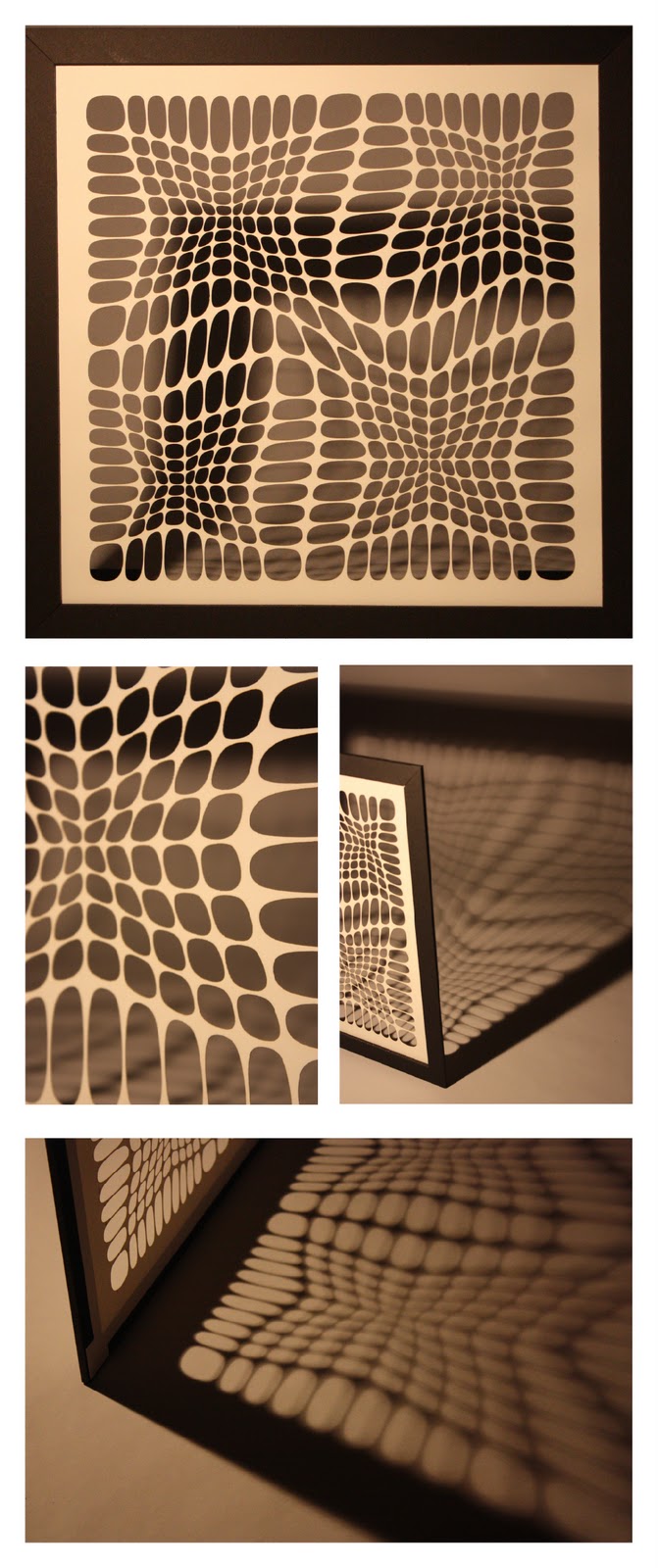
This is a continuation of the earlier screen studies. These screens begin to look at not removing as much material and designing areas where a person may not be able to see through the screen. A possible application for this would be to design privacy in certain areas and allow for direct visual access in others.




Sunday, November 13, 2011
Knife Cutter
This is a current group project in our Digital Fabrication course. We are researching the curved crease to generate forms out of .02 PETG. We finally got the knew knife cutter in the fab lab and had it up and cutting for us the day after we were trained! The tool that does the creasing for us doesn't cut anything, just presses into the material and the PETG folds up really easily afterwords. This particular form works through some of our connection and assembly issues before we get moving on the large installation (still to be designed). This project in is collaboration with John Hilmes, Bennett Scorcia and Matthew Strong.


Monday, November 7, 2011
Screen Studies
This is a series of screen studies with different patterns intended to create various shadows and areas of greater or less density in the pattern. The study will be used to create a larger structure which will use varying densities in the pattern to create privacy and allow light to pass through. The screens also begin to become three dimensional depending on the manipulation of the material.


This set of screens uses the same pattern which has been slightly offset three times. Each screen set adds one additional layer of the pattern, and the final screen has rotated the pattern creating more density in the screen.


Subscribe to:
Posts (Atom)